POWER ENGINEERING

48 V power design

An engineering framework for wide-input conversion: operating limits, power components, loop behavior and thermal performance.

Discuss your design
SYSTEM DESIGN PERSPECTIVE FuuVeXia Engineering
48 V power design
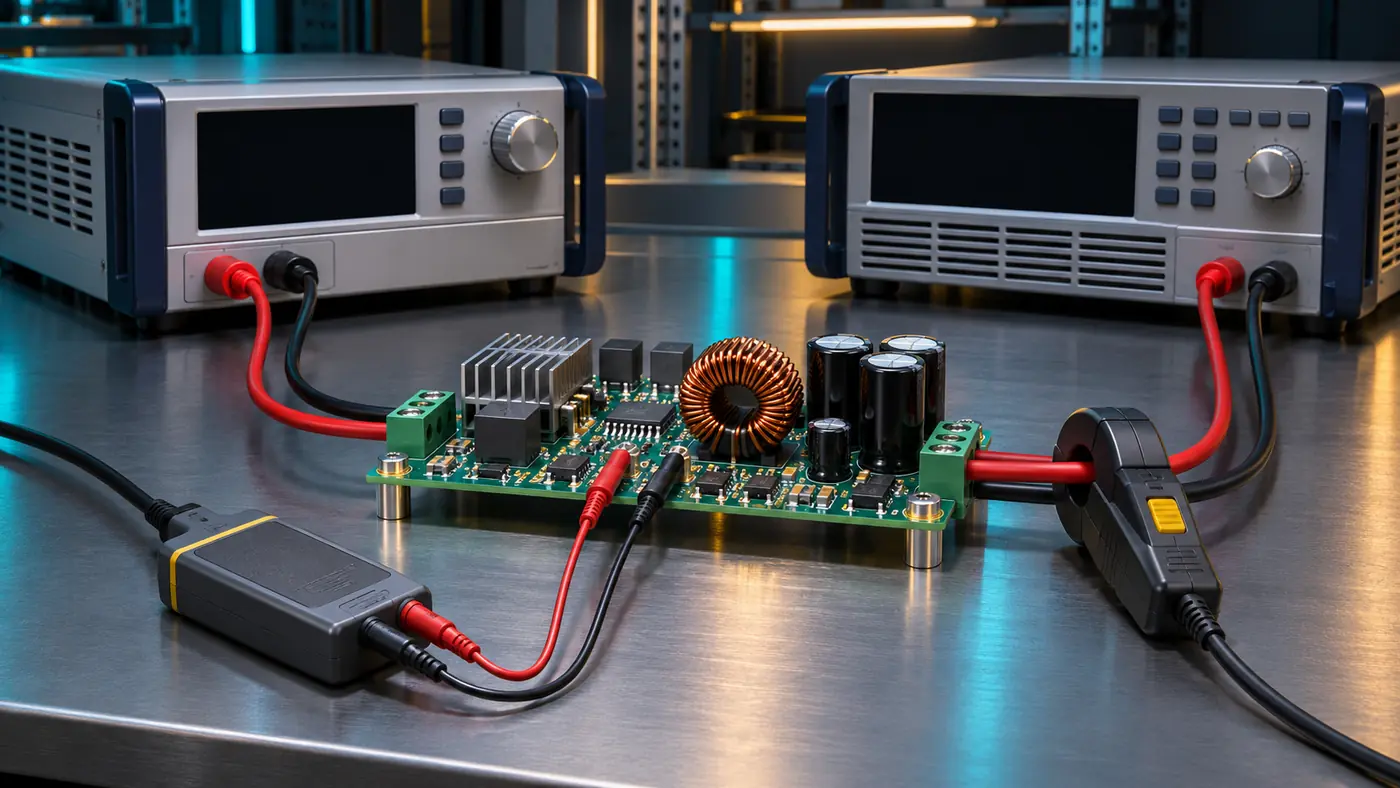
Original concept visualization
SYSTEM VIEW

The complete signal path.

Conceptual functional architecture. External components and interfaces depend on the final system design.

01

INPUT FILTER

→
02

SWITCHING STAGE

→
03

OUTPUT FILTER

→
04

FEEDBACK LOOP

Previous functional flow · retained
01INPUT FILTER
→
02SWITCHING STAGE
→
03OUTPUT FILTER
→
04FEEDBACK LOOP
01 / ENGINEERING

Operating limits are not absolute maximum ratings

The supplied 9–80 V input target needs to be separated from any transient-survival claim. A surge specification requires waveform, source impedance, duration and repetition. Confirm the controlled datasheet before defining clamp thresholds or component voltage margins.

02 / ENGINEERING

Evaluate the complete power stage

Controller choice does not determine output current by itself. External MOSFET resistance and switching losses, inductor saturation, current sensing and PCB copper all affect the available load envelope. Check the transitions between buck and boost operation.

03 / ENGINEERING

Measure losses and stability

Efficiency must be measured at stated input, output, load and temperature. Use load-step testing and appropriate loop measurements to assess stability. Junction-temperature estimates require a relevant board model; package thermal resistance is not a universal system constant.

DESIGN REVIEW

Make the requirements measurable.

Design considerationEvaluation focus
Input target¹9–80 V DC
Process¹180 nm high-voltage BCD
Package¹QFN-32, 5 × 5 mm
Efficiency target¹96.8% peak; operating point unconfirmed

¹ Where shown: preliminary portfolio target, not a guaranteed production limit.

Before design-in

  1. Measure no-load, light-load and full-load conditions.
  2. Capture switching-node overshoot with appropriate probing.
  3. Validate short-circuit recovery and thermal limits.
ENGINEER WHAT COMES NEXT

Your next design.
Our next conversation.

Talk to engineering